
Cannabis Dispensary Profit Margins: Real Revenue Data & Margin Optimization 2025

Cannabis Dispensary Profit Margins: Real Revenue Data & Margin Optimization 2025
Understanding cannabis dispensary profitability requires analyzing multiple revenue streams, cost structures, and market dynamics that vary dramatically by location and operational sophistication. While average dispensaries generate $2 million in annual revenue with 12-21% net margins, top performers achieve $5 million+ with 25-30% margins through strategic category management, operational efficiency, and high-margin accessory optimization.
This comprehensive guide breaks down real revenue data, profit margins by product category, hidden costs that erode profitability, and proven strategies for maximizing dispensary earnings in increasingly competitive markets. Whether you're evaluating a dispensary investment or optimizing an existing operation, understanding the complete financial picture determines long-term success.
Average Dispensary Revenue: Breaking Down the $2M Baseline
Industry Benchmarks: MJBizDaily's annual dispensary survey shows average annual revenue of $1.8-2.2 million for established adult-use dispensaries, with medical-only dispensaries averaging $1.2-1.5 million. However, these averages mask enormous variation based on market maturity, competition density, and operational execution.
Market-Specific Performance:
- Mature markets (Colorado, California, Oregon): $1.5-2.5M average, intense competition
- Growing markets (New Jersey, New York, Maryland): $2.5-4M average, less competition
- Limited license markets (Illinois, Massachusetts): $3-5M+, oligopoly pricing
- Saturated markets (Some California localities): Under $1M, survival challenging
Location matters more than almost any other factor. A dispensary in a limited-license Illinois suburb might generate $4 million annually with minimal competition, while a San Francisco dispensary 2 blocks from 5 competitors struggles to reach $1.5 million despite higher foot traffic.
Revenue Per Square Foot: Top-performing dispensaries achieve $800-1,200 per square foot annually. A 1,500 sq ft store hitting $900/sq ft generates $1.35M revenue. Optimizing floor space for high-margin categories (accessories, pre-rolls, concentrates) versus low-margin flower significantly impacts this metric.
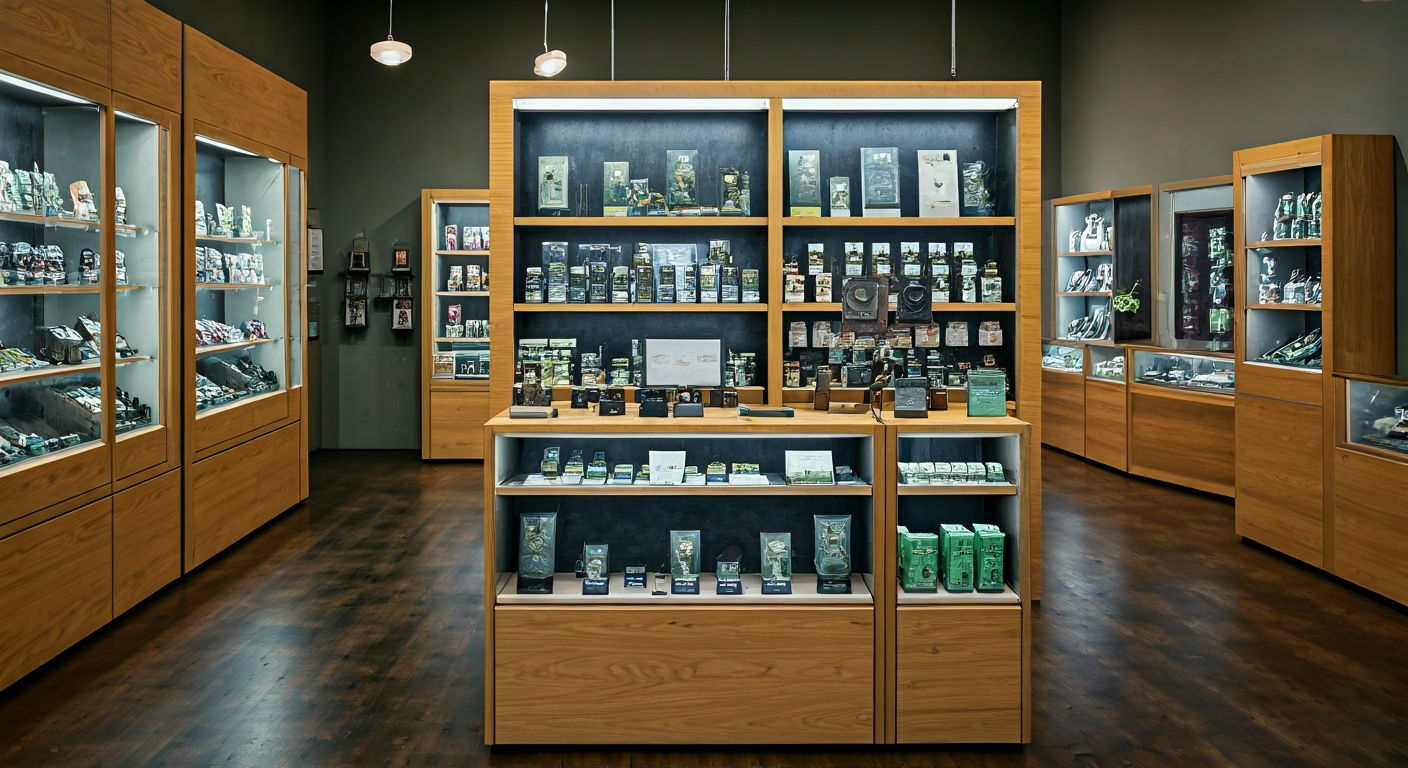
Profit Margins by Product Category: Where Money Is Actually Made
Understanding category-specific margins reveals why accessory sales matter so much to overall profitability:
Flower (35-45% of revenue, 15-25% gross margin): Cannabis flower represents your highest revenue category but lowest percentage margin. Wholesale costs of $1,200-1,800 per pound against retail prices of $2,000-2,800 per pound create 20-25% margins before overhead. Flower drives traffic but doesn't drive profit.
Pre-Rolls (10-15% of revenue, 30-40% gross margin): Higher margins than flower because you add labor value. Pre-rolls made from trim and shake purchased at $200-400/pound sold at $8-15 per gram create excellent margins. However, labor costs reduce net margins.
Concentrates (15-20% of revenue, 25-35% gross margin): Wax, shatter, and vape cartridges offer better margins than flower but face pricing pressure from wholesale competition. Margins compress as markets mature and concentrate supply increases.
Edibles (10-15% of revenue, 30-45% gross margin): Packaged edibles from licensed manufacturers provide solid margins with minimal handling requirements. However, regulatory restrictions on dosing and packaging limit pricing flexibility.
Accessories (5-10% of revenue, 50-70% gross margin): This is where dispensaries make real money. Grinders purchased at $5 wholesale sell for $15-25. Rolling trays with $8 cost sell for $25-35. Custom rolling papers offer 60% margins. Vape batteries and smoking accessories generate 3-4x margins on capital invested.
Despite representing only 5-10% of revenue, accessories often contribute 20-30% of gross profit dollars. A $100,000 accessory category at 60% margin generates $60,000 gross profit - the same as $300,000 in flower sales at 20% margin. This is why optimizing accessory sales dramatically improves overall profitability.
Hidden Costs That Destroy Dispensary Profits
Naive revenue projections ignore operational realities that separate profitable dispensaries from struggling ones. Here are the cost categories that erode margins:
Taxation Nightmare - 280E: Federal tax code 280E prohibits cannabis businesses from deducting normal business expenses (rent, payroll, marketing, utilities) because cannabis is federally illegal. You can only deduct Cost of Goods Sold. This creates effective tax rates of 60-75% for profitable dispensaries.
A dispensary with $2M revenue and $300,000 net income before taxes might pay $225,000+ in federal taxes (75% effective rate). Understanding this impacts pricing strategy, expense management, and expected owner earnings. Many dispensaries that look profitable pre-tax become marginal after 280E taxation.
Security and Compliance Costs: Budget $100,000-150,000 annually for:
- Armed security guards ($50-80K/year)
- Surveillance system monitoring and maintenance ($10-15K/year)
- Armored car services for cash transport ($25-40K/year)
- Compliance software and seed-to-sale tracking ($15-25K/year)
- Regular compliance audits and consulting ($10-20K/year)
These costs are non-negotiable and significantly higher than equivalent retail businesses. Factor them into profitability calculations from day one.
Shrinkage and Theft: Cannabis businesses face 3-7% shrinkage rates (versus 1-2% for traditional retail) due to employee theft, robbery risk, and inventory management challenges. On $2M revenue, 5% shrinkage equals $100,000 in lost product annually.
Implementing strict inventory controls, regular audits, and employee screening reduces shrinkage. However, zero shrinkage is unrealistic - budget 2-3% minimum even with excellent controls.
Owner Income Reality: $250K-500K Average But Wide Variation
Dispensary owner earnings depend on business structure, market conditions, operational efficiency, and whether owners draw salary versus taking distributions:
Solo Owner-Operator Model: Single-location owners actively managing daily operations typically take $150,000-300,000 in combined salary and distributions. This assumes $2M revenue, 15% net margin ($300K profit), with half as salary and half as distributions.
Multi-Location Operators: Owners with 3-5 locations and professional management teams can achieve $500,000-1,000,000+ annual income. However, this requires substantial capital investment ($1M+ per location) and sophisticated operational systems.
Investor-Only Owners: Passive investors receive distributions based on ownership percentage and profitability. In high-performing dispensaries, 20% ownership stake might generate $100-150K annually without operational involvement.
Market maturity significantly impacts earnings trajectory. Early market dispensaries often see declining owner income as competition increases - first-year earnings of $400K might drop to $200K by year 3-4 as markets saturate.

Maximizing Profitability: High-Margin Category Optimization
Smart dispensary operators recognize that overall profitability depends less on flower sales and more on optimizing high-margin categories that customers treat as impulse purchases or necessary accessories:
Accessory Category Expansion: Increasing accessory revenue from 5% to 12% of total sales can add $140,000 annual revenue. At 60% margin, that's $84,000 additional gross profit - equivalent to adding $400,000+ in flower sales. Stock comprehensive selections of grinders, rolling trays, ashtrays, lighters, and storage solutions.
Private Label and Custom Branded Products: Developing house-brand accessories with your dispensary logo creates 70-80% margins while building brand equity. A customer who buys your branded grinder uses it daily, reinforcing your brand hundreds of times. Partner with wholesale manufacturers like MunchMakers for low-minimum custom branding on grinders, trays, papers, and more.
Bundle Creation and Upselling: "Starter Kits" combining flower with grinder, papers, and tray increase transaction values 40-60%. Price bundles at slight discounts versus individual items while still maintaining 35-40% blended margins. Train staff to suggest bundles to every first-time customer.
Premium Product Positioning: Create "premium corners" featuring high-margin items - exotic strains at $50-60/eighth, luxury accessories, concentrate devices, and artisan products. Customers seeking premium experiences will pay significantly more, driving margins on 15-20% of transactions.
Real Dispensary Profitability Scenarios
Scenario A - Struggling Dispensary (Saturated Market):
Revenue: $1.2M annually
Gross Margin: 22% ($264K)
Operating Expenses: $280K
Net Loss: ($16K)
Owner Income: $0 (owner takes minimal salary to keep business alive)
Scenario B - Average Dispensary (Competitive Market):
Revenue: $2M annually
Gross Margin: 25% ($500K)
Operating Expenses: $350K
Net Profit: $150K
Taxes (280E): $110K
Net After Tax: $40K
Owner Income: $120K (includes $80K salary + $40K distribution)
Scenario C - Optimized Dispensary (Accessories Focus):
Revenue: $2.2M annually (12% accessories vs 5% typical)
Gross Margin: 28% ($616K) - higher due to accessory mix
Operating Expenses: $350K
Net Profit: $266K
Taxes (280E): $200K
Net After Tax: $66K
Owner Income: $186K (includes $120K salary + $66K distribution)
Notice how Scenario C generates 55% more owner income than Scenario B simply by optimizing accessory sales. The revenue difference is only $200K, but the margin improvement creates $120K additional profit pre-tax and $66K more after-tax income.
Conclusion: Profitability Requires Strategic Category Management
Dispensary profitability depends far less on total revenue and far more on category mix, margin optimization, and cost control. Owners who treat their businesses as "flower stores with accessories" leave massive profit on the table compared to those who strategically develop high-margin categories alongside cannabis sales.
Focus on: accessory category expansion, private label development, bundle creation, premium positioning, and staff training on margin-conscious selling. These strategies separate $120K owner income from $300K+ owner income at similar revenue levels.
Ready to optimize your dispensary's accessory category and improve margins? Partner with MunchMakers for wholesale custom-branded smoking accessories that build your brand while delivering 50-70% profit margins on every sale.